Courthouse mob
The Outsider (Stephen King Edition)The Courthouse mob is the public campaign of condemnation that gathers around Terry Maitland after his arrest for Frank Peterson’s murder. In Flint City, fear for children and confidence in a seemingly conclusive case harden into demands for execution before trial. The crowd’s chants, signs, and assaultive rush turn a legal transfer into a public punishment ritual; the violence culminates in Terry’s fatal shooting outside the courthouse. Set against that spectacle, his restrained kindness toward a man who has just helped threaten him makes the crowd’s certainty look less like justice than a refusal to see the accused as a person.
Fear Becomes a Public Verdict
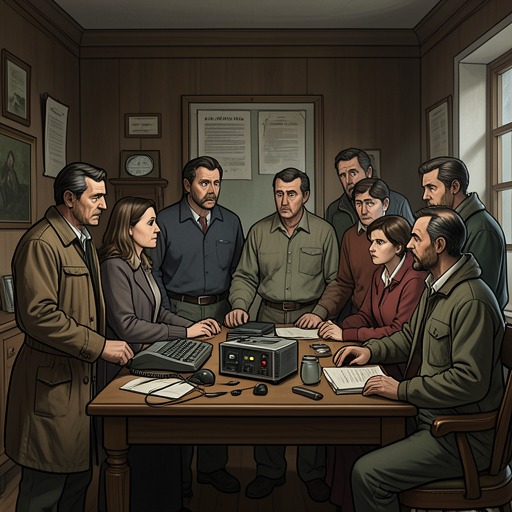
The crowd’s anger has an explicit civic context. In the pre-arrest discussion, district attorney Bill Samuels tells Ralph Anderson that parents of young children are terrified and angry and want an arrest quickly so they can feel safe. He also calls the evidence ironclad. Ralph has misgivings about moving before the background is complete and anticipates that Terry will assert an alibi, but Samuels argues that waiting is not the right course. The decision to arrest under pressure thus precedes the spectacle at the courthouse: public fear is not merely a reaction to the case but part of the rationale for acting before every uncertainty has been resolved.
That confidence rests on evidence that appears overwhelming at the time. At the baseball field, Detective Ramage publicly identifies Terry as the suspect in Frank Peterson’s murder before a crowd of 1,588. Later, Ralph describes fingerprints on the white van, Frank’s bicycle, a toolbox, the Subaru switched behind Shorty’s Pub, and the branch used in the assault; Samuels adds that the prints on the branch are in Frank’s blood. The physical evidence gives the accusation a forceful, concrete form. Yet Terry’s alibi remains a problem for the case: at three o’clock, around the time a witness placed Terry with Frank, Terry was attending a speech in the Sheraton’s meeting room across from its banquet room. The clash between the case’s apparent certainty and the alibi is precisely what the public spectacle suppresses.
The Journey to Arraignment
By the morning arraignment, the courthouse has become a stage. Since the old courthouse beside the jail closed, prisoners must be transported six blocks to the new glass building nicknamed the Chicken Coop. Police cars, a short blue bus, and Howie Gold’s black SUV wait outside the jail while reporters, camera operators, spectators, and sign-holders gather behind barriers. Signs demand execution and damn Terry to hell. Howie guides Marcy away from the most exposed side of the vehicle, but she sees the signs and begins to sob; the press asks whether Terry told her what he would do and whether she tried to stop him.
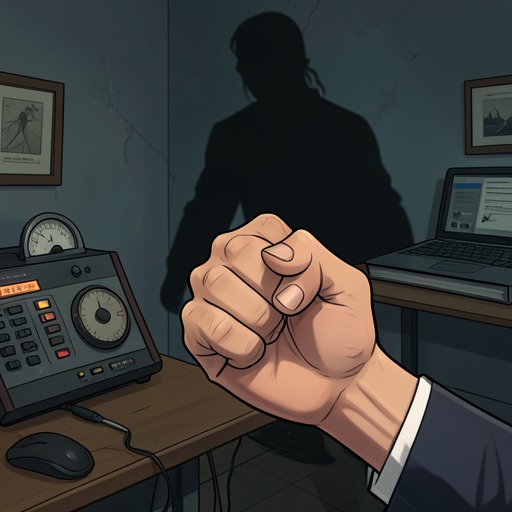
The abuse starts before the procession reaches the courthouse. Prisoners in the bus press their faces to its wire mesh and shout insults and predictions that Terry will be executed. Once the vehicles arrive, the crowd’s anger becomes a chant. A shout of “Needle, needle!” spreads through the gathering until it is repeated like a sports cheer. Terry looks at people he knows—parents of children he taught and coached, people he had welcomed to end-of-season barbecues—now urging his death. Reporters and townspeople surge past a sawhorse barricade, and phones rise to record the scene. The familiar community of teacher, coach, neighbors, and families is recast as an audience for punishment.
Marcy and the Edge of Mob Violence
The hostility also targets Marcy, not just the accused. When a burly spectator overturns a barrier and rushes her, shouting an accusation that she covered for her husband, Howie intercepts him and knocks him aside. The act makes plain that the crowd’s judgment has widened beyond Terry: association with him is enough to make Marcy a target. Howie’s attempt to shield her, and his insistence that she keep her head down and move without responding, are practical defenses against a gathering in which accusation is being acted out physically.
The authorities struggle to recover control. Some spectators climb the courthouse steps despite police efforts to push them back; bailiffs try to clear space, but others surge forward to take the places left open. The sheriff wants Terry moved inside immediately, while the assistant district attorney argues that he should be returned to the car until order is restored. Ralph and Yunel Sablo take point as the escort proceeds. The crowd chants for Terry to die while he climbs the steep steps in handcuffs, and Marcy reaches toward him before the sheriff pushes her back. At that moment the courthouse is not yet a courtroom of deliberation: it is a threshold surrounded by people demanding a sentence before any trial.
The Man in the Newspaper Sack
Ralph’s attention catches on a man wearing a knit cap in the summer heat and carrying a canvas newspaper sack marked with the name of the Flint City Call. The disguise and the red hair beneath the cap recall Ralph’s interview with a witness who had described seeing Frank with Terry and explained that both Peterson boys were redheads. She had also said the man she knew had once delivered her newspaper. The resemblance changes the scene from a general threat into a specific danger. The man is Ollie Peterson, and he has come armed with a revolver.
As the crowd presses around the courthouse steps, Ollie fires toward Terry. Ralph shoots, but a fleeing spectator collides with him; his bullet strikes a television camera and wounds the cameraman instead. Ollie fires again, and Terry is hit. Marcy runs to her husband as Ralph fires once more, killing Ollie. The crowd’s movement and the shooting have now carried the public spectacle into fatal violence. Terry does not survive to enter the courthouse, and the arraignment that the procession was meant to reach is displaced by the emergency outside its doors.
A Counterimage to Retribution
In the confusion, Terry helps a man in a cowboy shirt get back to his feet, despite being handcuffed and spat upon. Ralph remembers the gesture long afterward: the accused offers help to someone on the side of the crowd that has turned against him. The moment does not settle the case, but it sharply contrasts Terry’s action with the crowd’s insistence that he deserves death. It also explains why the episode remains with Ralph: amid the public performance of certainty, a small, unforced act of decency is harder to reconcile with the role the crowd has assigned Terry.
The public verdict proves both premature and irreversible. Much later, Samuels addresses why the case against Terry proceeded, acknowledging that authorities did not have all the relevant facts on the day of the arrest or arraignment. He also explains that the DNA evidence that seemed to match Terry came from mixed samples at Figgis Park, containing DNA from both perpetrator and victim, and so could not be treated as infallible. That later explanation does not undo the crowd’s chants, the attack on Marcy, or Terry’s death. The Courthouse mob therefore binds together two failures of judgment: official action taken amid unresolved questions and a community that converts the accusation into a demand for immediate punishment. Its lasting significance lies in the gap between what the crowd believes it knows and what the evidence can actually establish.